



Ball Skills Before Walking: A Parent's Guide to Infant Ball Games
Ball games help babies develop coordination, gross and fine motor skills, hand-eye coordination, and early cognitive abilities like problem-solving and decision-making. Most babies can begin engaging with soft, lightweight balls from around 4-6 months, once they can grasp and release objects. Regular ball play in the first 18 months builds the neural foundations for confident movement, sport, and physical activity for life.
The phrase "they came out of the womb kicking a football" is usually treated as hyperbole. But for many naturally able athletes, it's closer to the truth than it sounds — because the foundations of ball skill are laid in the first eighteen months of life, long before a child can walk, run, or kick anything intentionally.
In our combined thirty-plus years working with young children in physical education, the single biggest predictor of confident ball skills at age four isn't talent — it's how early and how often a child was given a ball to play with.
How do ball games help baby development?
Ball play develops what sport scientists call object control skills — one of the two pillars of fundamental movement skills (FMS), alongside locomotor skills like running and jumping. Object control skills include catching, throwing, rolling, and striking, and they're the building blocks of almost every sport a child will go on to play.
A study in the Journal of Sport and Health Science (Logan et al., 2017) found that children who engaged with ball games showed significantly better coordination, balance, and agility than peers who didn't. Research in the Journal of Child Psychology and Psychiatry (Schott and Hagemann, 2019) further showed that ball-based play improves processing speed and inhibition — cognitive abilities that matter on the sports field as much as physical ones. Ball play also builds bilateral coordination (using both sides of the body together), visual tracking, and crossing the midline — three neurological skills that underpin reading, writing, and athletic performance later in childhood.
When can babies start playing with balls?
Babies can begin interacting with balls from birth through visual tracking — watching a slowly rolled ball moves the eyes and stimulates early neural pathways. Active play begins around 4-6 months, when most babies can reliably grasp and release objects. By 8-10 months, babies can sit independently and roll a ball back and forth. By 12 months, many can throw, drop, and chase balls. By 18 months, basic kicking and two-handed throwing are emerging.
This timeline aligns with the World Health Organisation's physical activity guidelines for under-5s, which recommend that infants under one year are physically active several times a day, particularly through floor-based play. Ball play is one of the easiest ways to meet that target.
What is the best first ball for a baby?
The O-ball is widely considered the best starter ball for infants. Lightweight and built from a soft, flexible plastic lattice, it's specifically designed for small hands to grip through its open structure. The O-ball can be introduced from around 3-4 months, as soon as a baby starts grasping objects intentionally.
The O-ball develops fine motor skills as the baby practises grasping and releasing, and supports gross motor development as the baby rolls, tosses, and crawls after it. The bright colours add visual stimulation, and the soft material means it's safe to gum and chew. One word of warning — once your baby can release the ball, expect to spend a lot of time retrieving it from under furniture.

Are balloons safe for babies to play with?
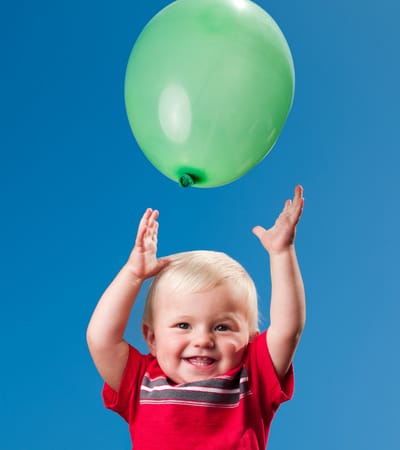
Balloons are an excellent ball-play tool for infants and toddlers, but they require constant supervision. Uninflated or burst balloon fragments are a serious choking hazard for children under three. With direct adult supervision, an inflated balloon is one of the most useful early ball-skill tools available.
Because balloons fall slowly and unpredictably, they give babies more time to react than a standard ball would. This makes them ideal for developing hand-eye coordination, visual tracking, and early striking skills. They also build sensory and auditory development through the texture of the surface and the sound of contact.
One pattern we see consistently: babies who spend regular time tracking and reaching for rolling balls and balloons during tummy time tend to develop sharper visual tracking and faster reaction times once they're upright.
What balloon games can I play with my baby?
Balloon tapping: Hold the balloon in front of your baby and encourage them to tap it. Works from around 4 months while lying down or sitting supported. Teaches cause and effect alongside hand-eye coordination.
Balloon catch: Sit facing your baby and gently toss the balloon between you. Suitable from around 9-12 months, once your baby can sit independently and reach with both hands.
Balloon keepy-ups: Work together to keep the balloon airborne. The slow, unpredictable movement forces real concentration and timing — ideal for 12-18 months.
Balloon volleyball: Use a sheet on the floor as a net. Encourage your baby to hit the balloon over the net using their hands. Best for confident toddlers from 18 months who are starting to direct their movements with intent.
What about soft sponge balls?
Soft sponge balls are the natural next step after the O-ball, suitable from around 6 months. They're light enough to be safely thrown indoors, easy for small hands to grip, and ideal for the first true catching and throwing games. Try rolling the ball back and forth across the floor, encouraging your baby to push it back. As they progress, introduce simple basketball-style games — a laundry basket on the floor and an encouraging "go on, throw it in" works brilliantly with toddlers from 12 months.
Gradually increasing the difficulty — moving targets, smaller containers, different ball sizes — strengthens the neural connections linked to coordination and proprioception, with a long-lasting impact on athletic performance.

How can parents develop their child's ball skills at home?
Start early: Introduce soft balls from around 3-4 months, as soon as your baby is grasping objects. Visual tracking starts even earlier.
Focus on the basics: Catching, throwing, rolling. Build complexity slowly — change one variable at a time (size, distance, speed).
Use variety: Different sizes, weights, textures, and colours. Variety builds a richer motor vocabulary than repetition with a single ball.
Be patient and positive: Coordination develops over months, not days. Celebrate effort, not just success.
Practise daily: Five to ten minutes of focused ball play, every day, beats one long session a week.
Parents often ask us when to introduce a "proper" ball — a football, basketball, or tennis ball. Our answer is rarely, in the first eighteen months. Variety beats specificity at this age. A baby who has handled twenty different balls of different sizes, weights, and textures develops a richer motor foundation than one who has only ever played with a single football.
Every child develops at their own pace, so don't compare your baby's progress to others. Focus on consistent, joyful daily play — and don't hog the ball.
Take it further
Ball skills are one part of a much bigger picture. The Infant to Athlete course covers fundamental movement skills, motor development, and infant brain development across eight animated sessions and 32 chapters — built on 100+ scientific studies and 30+ years of combined coaching experience. Click here to give your child the best possible start.
References
Logan, S. W., Barnett, L. M., Goodway, J. D., Stodden, D. F. (2017). Promoting Fundamental Movement Skill Development and Physical Activity Behaviors Among Children: A Systematic Review and Meta-Analysis. Journal of Sport and Health Science, 6(2), 201-211.
Strouse, G. A., Borden, L. A., & Flores, J. J. (2016). Teaching children to play: A review of the literature and implications for physical education. Journal of Applied Developmental Psychology, 45, 33-44.
Schott, N., & Hagemann, N. (2019). Cognitive training in young children by playing a digital ball game improves processing speed and inhibition. Journal of Child Psychology and Psychiatry, 60(10), 1075-1082.

Gary South
Gary is the founder of Infant to Athlete and has consulted on Physical Education and sports coaching internationally.
Or if you just want our latest articles sent directly to your inbox:
Created with ©systeme.io